


FLOWERS Collection
New Limited Edition Series, celebrating nature, beauty, and human connections.


From a Castle in Italy,
to Your Art Collection.
SIX LIMITED EDITIONS, ONLY 50 PIECES EACH
In this Collection, Italian artist Daniel Salvi revisits one of his defining themes: the Nymphs, expanding their world through a new body of works: FLOWERS.
First unveiled during the FLOWERS exhibition inside a historic Italian castle, the series was presented as a celebration of beauty, human connection, and the timeless symbolic language of flowers.
Today, these artworks are available directly from the artist’s studio, offering collectors the opportunity to acquire a piece of the original exhibition.
Each artwork belongs to a strictly limited edition of 50, produced in Italy, to exhibition standards. Every piece is individually hand-numbered, titled, signed by the artist, and accompanied by its Certificate of Authenticity.
The complete collection is available for acquisition until August 23, 2026.
Profy Countdown Timer: Visible on Live site


EXHIBITION
FEATURED IN:


ABOUT ARTIST DANIEL SALVI
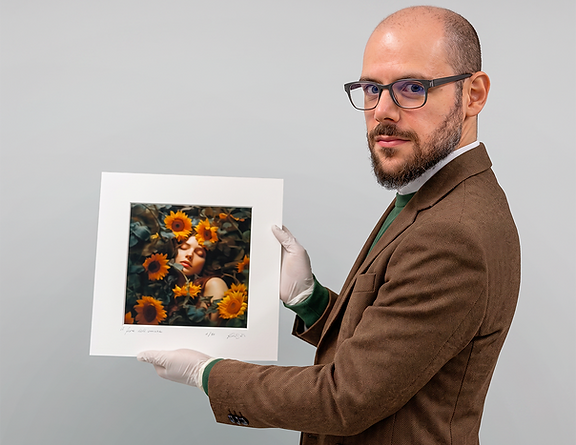
Daniel Salvi (b. 1994) is an Italian artist and creative director based in Milan, whose multidisciplinary practice spans fine art, digital creation, and multisensory installations, exploring the intersection between mythology, femininity, and contemporary spirituality.
Through his signature series Goddesses & Muses, Salvi blends photography, artificial intelligence, and digital painting into hybrid works that reinterpret classical and Renaissance archetypes for the present day.
Guided by his philosophical and ecological thought, his work envisions a renewed dialogue between humanity and nature, seeking to evoke empathy, solace, wonder, and emotional healing.
His practice extends beyond the visual, incorporating sound and scent to transform the act of viewing into a ritual of reflection.
Salvi’s projects have been presented in solo exhibitions and cultural initiatives in Italy and abroad, including his ongoing collaboration with the international charity organization Colors for Peace, where he has served as Brand Communication Officer since 2021.
APPEARED ON:


ARTIST'S PROJECTS EXHIBITED AT:



Timeline and more information
JULY 23 – Collection Launch
The Flowers Collection becomes available exclusively on danielsalvi.art.
This date marks the beginning of the limited acquisition window.
AUGUST 23 – Acquisition Window Closes
No further acquisitions are possible after this date.
AUGUST 24 to SEPTEMBER 23 – Production
All orders placed are produced and hand-finished for shipping.
SEPTEMBER 24 – Shipping
All orders placed are included in this dispatch.
RELATED STORY
Flowers, Nymphs, Women :
The Divine Embodiment of human bonds.
Daniel Salvi and the praise of the human trinity of emotions.


For millennia, the figure of the nymph has traversed the history of art — from archaic Greek civilizations to the Renaissance, through Symbolism and the Pre-Raphaelites — as a living bridge between humanity and nature, a symbol of beauty, metamorphosis, and mystery.
Daniel Salvi’s work gathers this legacy and reinterprets it for the contemporary age, transforming the nymph into a liminal apparition that embodies an archetype of emotional and spiritual force. Through a visual language that merges photography, artificial intelligence, digital painting, and retouching, Salvi restores to these figures a new aura — suspended, intimate, and profoundly human.
His nymphs are neither idealizations nor objectifications: they are living beings, divinized yet imperfect, contemplative yet vulnerable, mirrors of a universal interiority.
They do not represent womanhood as a prescriptive model, but humanity filtered through feminine experience, a gesture that rescues the feminine from its long history of passive representation and returns to it symbolic centrality and narrative power.

Sandro Botticelli, Primavera (c. 1482). Tempera on panel, 202 × 314 cm (80 × 124 in). Uffizi Gallery, Florence. Left to right: Mercury, the Three Graces, Venus, Flora, Chloris, Zephyrus.

Daniel Salvi, The Nymphs of the Snow (2024). Fine Art Print on cotton paper, Unique piece, 150 cm (59 in) x 113 cm (44,4 in)..
The bond between nymph and flower is not decorative, nor aestheticized: it recalls the ancient animistic worldview in which every natural element possesses a soul. The flower is not an object, but a vital principle that finds embodiment in the mythical figure; a cultural symbol that, through the nymph, becomes a living presence.
From this logic emerges the Flowers collection, in which three figures — inspired by the rose, the white lily, and the sunflower — embody the symbols of the three primary bonds of human existence: love, family, friendship.
Three archetypes that, in the artist’s vision, compose a kind of emotional and human trinity in which our affective identities overlap: in our lives, anyone can be at once family, friend, partner.
The Red Rose — The Flower of Love
The red rose is one of the most symbolically rich flowers, already present in ancient cultures where it appeared associated with Aphrodite, the goddess of love, and later transfigured in Christian symbolism as the Rosa Mystica of the Virgin Mary.
Throughout art history, the red rose has represented desire, passion, and beauty that can vanish in an instant.
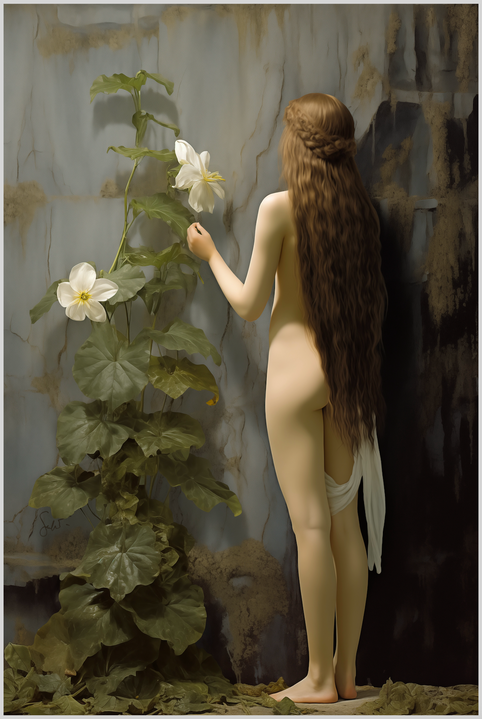
Daniel Salvi, Resilience and Blooming (2024). Fine Art Print on cotton paper, Unique piece, 66,7 cm (26.25 in) x 100 cm (39.37 in).
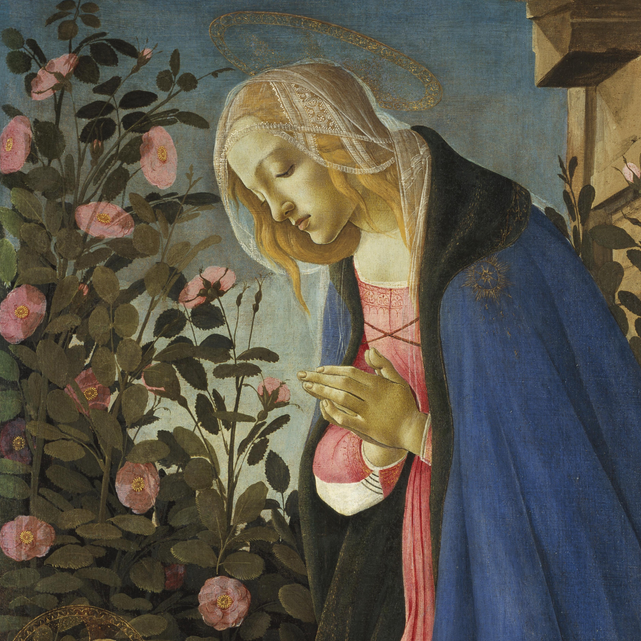
Sandro Botticelli, The Virgin Adoring the Sleeping Christ Child (Particular) (c. 1485). Tempera and gold on canvas, 122 x 80.3 cm (48 x 31.6 in) National Galleries Scotland
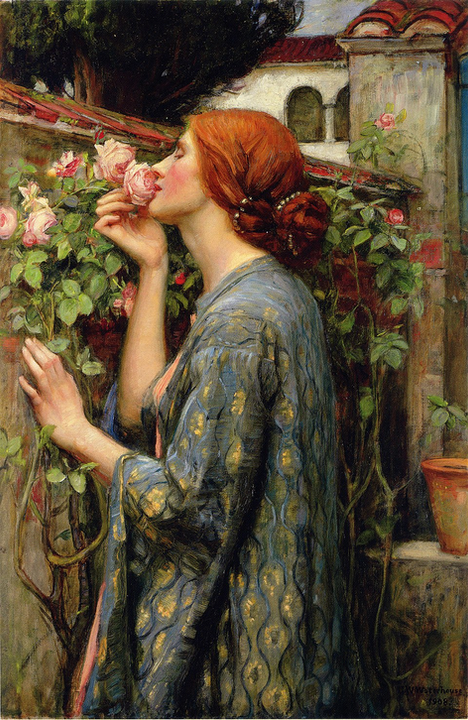
John William Waterhouse, The Soul of the Rose (1903). Oil on canvas, 88.3 x 59.1 cm. Private collection
For Daniel Salvi, however, the rose is not just a romantic metaphor: it is a vital arrow, a heartbeat, a promise and a risk.
The rose-nymph he imagines guards passion as destiny — a life that chooses, desires deeply, and welcomes without fear.

The White Lily — The Flower of Life
The white lily stands among the most iconic flowers of Western art. Already a symbol of purity, regeneration, and renewal in the ancient Mediterranean, it becomes in Christian tradition the sacred flower of the Annunciation, offered by the archangel Gabriel to the Virgin Mary — the archetype par excellence of motherhood, care, and life.
In Salvi’s imagination, the lily likewise speaks of life — and therefore of roots and family. It protects, embraces, and sustains. Its presence is quiet yet central, like the vital pillar of familial love.

Leonardo da Vinci, Annunciation (Particular) (c. 1472-76). Oil and Tempera on poplar panel, 98 cm × 217 cm (39 in × 85 in), Uffizi Florence

William-Adolphe Bouguereau, La Vierge au lys (The Madonna of the Lilies) (1899). Oil on canvas, 27 cm × 18.5 cm (11 in × 7.3 in), Private collection.
In the Flowers collection, the white lily thus becomes life and family — where one comes from, or where one chooses to return.
It is not prescriptive, but emotional: a place of origin and belonging.
In the 17th century, artists such as Nicolas Poussin and Peter Paul Rubens further amplified this visual code: in their mythological representations, nymphs become part of narrative scenes that blend eroticism, dynamism, and theatricality. Nymphs and satyrs intermingle in exuberant dances that celebrate the vitality and irrepressibility of nature.
In this way, the nymph becomes a key figure across centuries of defiance against convention, capable of reconnecting human thought with its own flesh and needs, in sharp and unresolved contrast with eschatological and moral religious structures.
Despite her mythological origins, the nymph has endured for millennia as a concrete, secular vision of femininity—a pagan muse that has accompanied the history of art on its long path toward modernity.

The Sunflower — The Flower of Friendship
Completing the floral triad is the sunflower — one of the most universally beloved symbols of contemporary culture for its connection to sunlight and warmth.
In art history, every appearance of the sunflower is eclipsed by one extraordinary chapter: Vincent van Gogh’s Sunflowers (1888–1889), a cycle that became the most famous floral series in art history, echoed across music, literature, and film.
Legendary is the story of how some of these sunflowers were painted to decorate the room of his friend Paul Gauguin, in anticipation of his arrival at the “Yellow House” in Arles. Even then, the sunflowers became a gift — a sign of welcome toward a friendship experienced as intense, creative, almost salvific.

Vincent van Gogh, Sunflowers (c. 1888). Oil on canvas, 92 x 73 cm, Alte Pinakothek Munich

Paul Gauguin, Sunflowers in a Chair, 1901, oil on canvas, 73 × 92.3 cm, State Hermitage Museum, St Petersburg
Since then, the sunflower carries the idea of friendship that supports, warms, and illuminates — not a light sentiment, but a bond that remains standing even when everything else falters.
For Salvi too, the sunflower is precisely this: the representation of the strength one receives through those who know how to return light.
The sunflower-nymph embodies the energy that lifts, the complicity that consoles, the presence that does not demand.
In the Flowers collection, it becomes the symbol of friendship as emotional alliance — a shared ray of light that makes the world inhabitable, a gesture that says “I am here,” and continues to shine, even only in memory.
The last two centuries, shaped by Romanticism and Symbolism, progressively dissolved the classical radiance of the nymphs to reveal their more ambiguous, unsettling, and deeply psychological nuances.
It is in this context that the figure of the nymph undergoes a fundamental metamorphosis: from idyllic personification of nature to emblem of the unconscious, desire, and danger.
No artist captured this tension better than John William Waterhouse.
Waterhouse, an English artist linked to the late wave of the Pre-Raphaelite movement, devoted much of his career to representing mythical, dreamlike, and powerful female figures. His nymphs are not harmless creatures: they are active agents, seductive and strong.

A Flower That Becomes Presence
Whichever flower one chooses — the gift offered is a presence filled with vitality and meaning.
Daniel Salvi’s nymphs do not represent flowers that will wither, but beings that will continue to live within the space and gaze of whoever welcomes them.
They guard emotions, accompany, observe, and return — like a gentle thought that never fades.
In a time when everything is rapidly consumed, these flowers become what remains: a bond that does not fade,
a gesture that does not exhaust itself,
a silent companionship that crosses the years.
It is not merely a gift: it is a lasting presence,
a symbolic soul that joins the life of the one who receives it,
a light that continues to be shared — again and again.
MORE FROM
FLOWERS Collection


Related Articles


